History
Henry the Navigator and the School of Sagres
Who the prince was, why he settled on this headland, and why historians doubt the famous school of navigators he is said to have founded here.
Check dates for the Lagos half-day tour ↗Quick answer
Henry the Navigator (1394 to 1460), a son of King João I, was granted this headland in 1443, founded a town here and died here in 1460. The famous "School of Sagres", a college of pilots, mapmakers and astronomers, is a tradition rather than a documented fact. Modern historians treat it as a misconception, and the story was built up by later writers.
Who Henry was
Henry was the third child of King João I of Portugal and his English queen, Philippa of Lancaster, and was born in Porto in 1394. At 21 he fought at the capture of Ceuta in North Africa in 1415, and he was made Duke of Viseu. From 1420 he ran the Order of Christ, the Portuguese successor to the Knights Templar, whose income helped pay for the voyages he sponsored. He was not a sailor himself. He organised, financed and licensed expeditions down the African coast, taking a share of their profits.
Why the headland at Sagres
On 27 October 1443 the crown granted Henry the land around Cape St Vincent for life, and Museus e Monumentos de Portugal says he was given leave to found a town on the Sagres promontory. A document of 1434 had called the area lonely and deserted. He named his settlement Vila do Infante, the Prince's Town, or "my town of Terçanabal". The Venetian navigator Alvise Cadamosto arrived there in 1454 and entered his service. Henry spent his last years in the western Algarve and died at Sagres on 13 November 1460.
Lagos was the working port
The ships themselves mostly sailed from Lagos, the real harbour of Henry's enterprise. In 1434 one of his captains, Gil Eanes, became the first known European to sail past Cape Bojador, after years of failed attempts. Between 1444 and 1446 as many as forty vessels left Lagos on Henry's behalf. The trade they opened brought gold and also enslaved Africans to Portugal, a part of the story that the Discoveries narrative long passed over.
Where the school story comes from
No document from Henry's lifetime describes a school at Sagres. Portuguese Wikipedia traces the idea to the English writer Samuel Purchas in 1625, building on a passage by the chronicler João de Barros. Eighteenth-century authors added an observatory, and by the 19th century the school was a national legend. English Wikipedia also cites the historian Edgar Prestage, who suggested that the presence of the mapmaker Jehuda Cresques at Henry's court probably accounts for it.
What historians say now
Henry did employ cartographers, but historians find no organised centre of navigation or observatory in the modern sense. Portuguese Wikipedia adds two points often made against the school. The Prince's Town only began to function around 1446, after the voyage past Cape Bojador. And Henry's will, which lists his foundations in detail, never mentions one. Some writers still allow for something smaller, such as an informal circle at court or a base in Lagos. Treat the "school" as a tradition about the place, not as a building you can visit.
A quote that kept the legend alive
Part of the legend's staying power comes from a real line. The 16th-century mathematician Pedro Nunes wrote of Sagres that "from it our sailors went out well taught and provided with instruments and rules". Read today, it describes a tradition of practical training, not a college with a building.
The name "Navigator"
Nobody called him that in his lifetime. In Portugal he is O Infante D. Henrique, the Prince Henry. English Wikipedia says the nickname was coined by two 19th-century German historians and spread by English biographies by Richard Henry Major in 1868 and Raymond Beazley in 1895.
What you can see of him
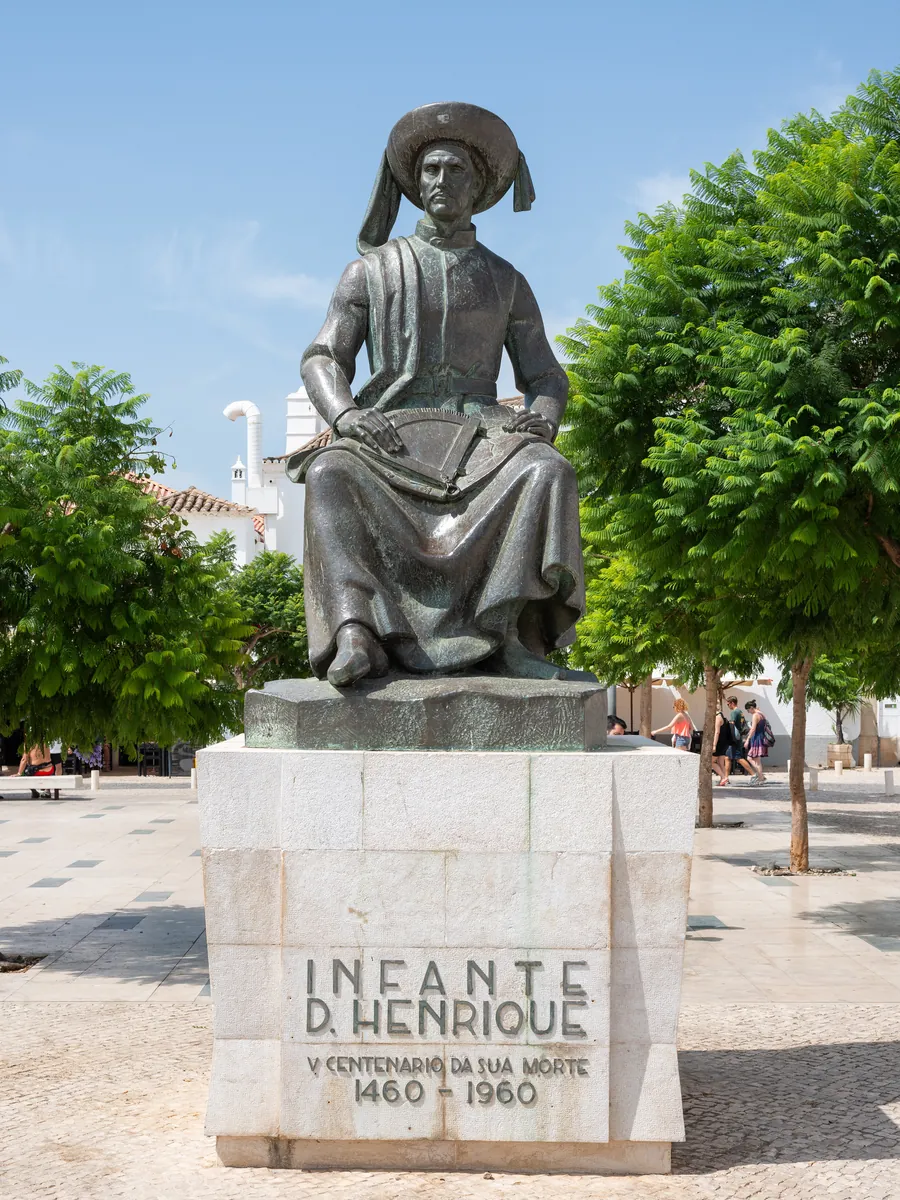
At the fortress, look for the cistern, traces of walls and the wind rose, which some link to his town, though none of it can be tied to him with certainty. He was buried first in Lagos and later moved to the Monastery of Batalha in central Portugal, where his tomb carries his motto, Talant de bien faire. In Lagos, a bronze statue by Leopoldo de Almeida, dated 1460 to 1960, stands on Praça Infante D. Henrique.
Frequently asked questions
Did Henry the Navigator found a navigation school at Sagres?
There is no evidence of one. Historians treat the School of Sagres as a later tradition.
Did Henry the Navigator live at Sagres?
Yes. He founded his town on the promontory after 1443 and died there on 13 November 1460.
Where is Henry the Navigator buried?
At the Monastery of Batalha, after a first burial in Lagos.
Why is he called the Navigator?
The nickname came from 19th-century historians. He never sailed on the voyages himself.
Sources